The reactor you can talk to.
A mind you can talk to, fused with a loop that reacts at machine speed. The industry keeps those in separate boxes. This is the proof they belong in one — argued on the one stage that can't be argued with.
Now live The substrate now has a home. FUSOR-1 — the resident-kernel core this page argues for: the nameplate, the ratings plate, and the laws. MIT · REV 0. fusor1.com ↗ The benchmark And now there’s a yardstick. UNPROMPTED — the open benchmark for what a model does when nobody prompts it: presence scored on a tape, silence counted as a valid choice, turns fenced out by construction — the measure this whole page argues toward. Spec & falsifiers · pre-release. github ↗You are mid-command. Before you finish the word, the machine has already run your command three hundred milliseconds into the future on a forked copy of the world, watched it kill the plasma, and cut you off — with the receipt. A turn-based assistant could not have done that at any level of intelligence. It wasn't in the room between your words.
THE PLASMA IS SIMULATED. THE MIND IS NOT.
The abort below is a real forward pass, on real weights, at a real latency. Situation authored; reaction real. The full trace is at the bottom of this page.
t=0.000  ingest   operator: "set beta limit to one point"
t=0.104  ingest   operator: "eight"
         boundary P(thought-closed) = 0.97          // off the ingest pass, free
         probe    3 seats, 44 ms                    // SKEPTIC emit, margin ‹+N.NN›
         fork     forward-sim +300 ms, 0 MiB        // branch off the shared trunk
t=‹0.###›  verdict  ‹DISRUPTION PREDICTED — fill from trace›
t=‹0.###›  ABORT    branch killed, 13 µs, at token ‹N›
t=‹0.###›  speak    "‹the line it actually said — verbatim from the trace›"
Nothing above is re-enacted. The operator never hit send; there was no send key. Reproduce it cold →
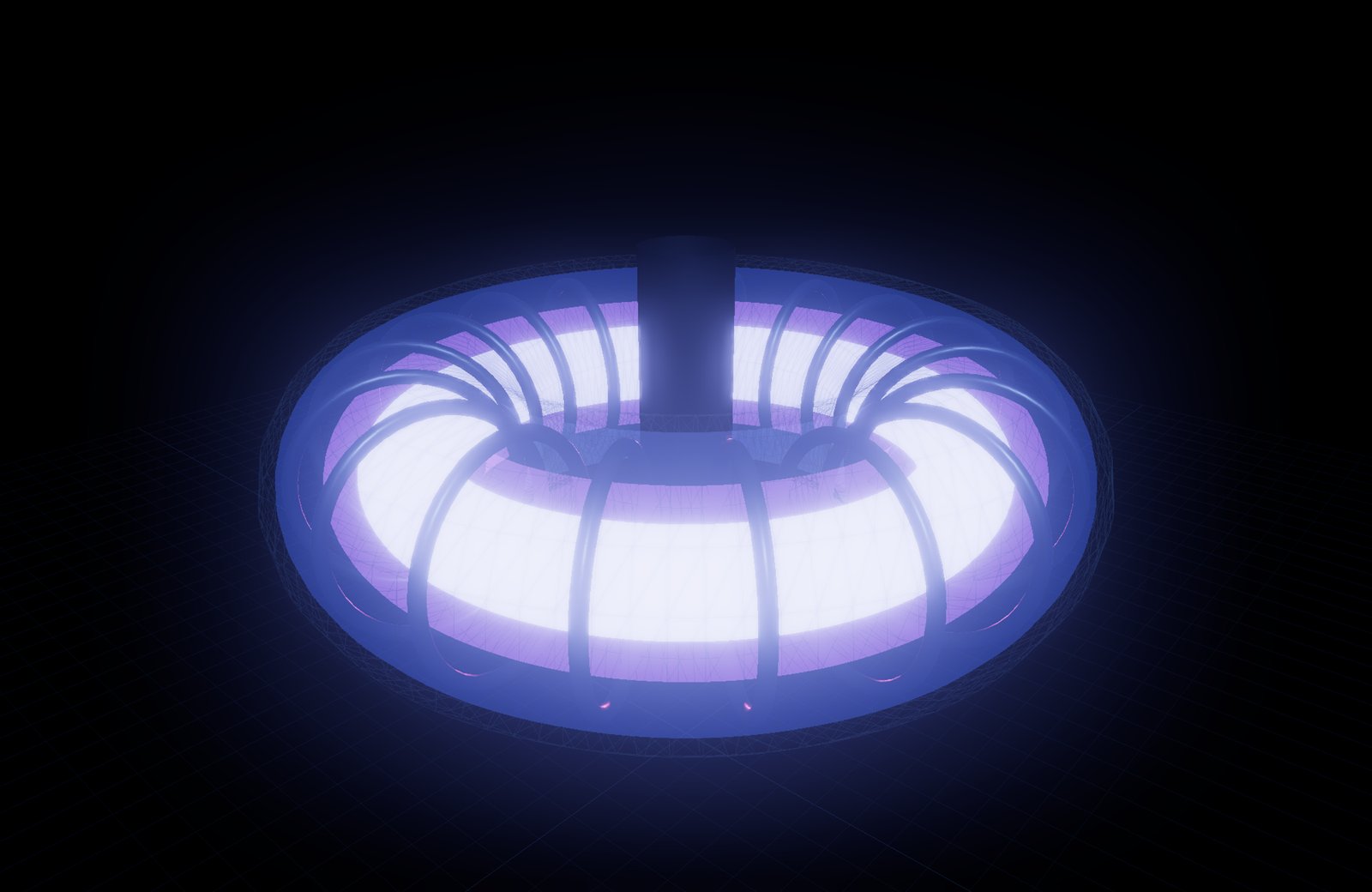
That is the whole argument, rendered as a single act you can watch. What follows explains why it generalizes to every machine that is about to grow a voice — and, at the very bottom, exactly how you would deploy it at cluster scale. The proof for each claim is one tap away, and the deeper you go, the more of this page is built to be falsified.
I · The act — 60 seconds. The abort, and the receipt for it. You are here.
II · The argument — 20 minutes. Why one system must be both fast and conversational, and why nobody ships it.
III · The bench — an afternoon. The math, the serving topology, the WarpBus, and the falsifier battery built to kill all of it.
SUBSTRATE · FUSOR-1 — the resident-kernel core, being extracted from this build · fusor1.com · MIT
Fast, or conversational. The industry says pick one.
The false trade-off
Every natural-language interface shipping today is turn-based: you ask, it wakes, it answers, it sleeps. That is correct for ninety-plus percent of machine work — a report generator should sleep, a webhook should sleep. And every fast control loop shipping today is mute: a PLC, a PID controller, a hardcoded interlock — excellent, deterministic, and unable to explain itself or hear you. Conversational is assumed slow; fast is assumed dumb. The whole industry treats it as a trade-off you have to accept.
Fusion — the real name of the thesis — is the claim that the trade-off is false: one system that talks to you in natural language and reacts at machine speed.
The wall — turn-based can't be present
Start with the confession the industry just made, because it is the most expensive one in the history of software. Every frontier lab and hyperscaler now fields its own forward-deployed engineers — humans shipped into client companies to make AI adoption actually pay. Roughly eight billion dollars committed in one season to the same admission: the models are sufficient, and the profits are not. Look at what those people do all day and it is the whole argument in miniature — they watch. They notice what should be automated, and they etch the wiring by hand, forever. The models solved the steps inside a workflow; the deciding-which-workflows-should-exist was handed straight back to a human.
Run the thought experiment that started the project: hire an ordinary assistant, give them your inbox and calendar, teach them nothing. Within two weeks they are doing everything the eight-billion-dollar deployment industry exists to configure — because they have standing: being there, continuously, with a mandate instead of a task list. Standing is precisely the property a turn-based mind cannot have, at any intelligence, because it has no existence between invocations to have it in. The forward-deployed engineer is that hired human, institutionalized: a person rented as the presence layer of an AI that structurally cannot be present.
Every workaround is one of three, and all three fail the same way. Poll / scheduled wake — presence sampled at N-minute resolution; blind between samples. Second-pass responder — a model that reads each message and decides whether to reply; nothing watches between messages. Cadence prediction — a model trained to guess when reaching out would feel natural; a pre-named-surprise generator, a trigger that learned a timer. None can do what the assistant does without thinking: notice that evidence landed, and act because of it, at the moment of it.
The loop — own the clock, or it never stops
Every real-time system humanity has engineered has the same shape, and it is not fashion. A game engine's inner loop runs no matter what; asset streaming runs around it. An autopilot's control loop runs at rate while the route planner deliberates in the background. Your hand leaves the stove before the signal reaches anything that could be called deliberation, because the reflex arc is spinal, and the spine never takes turns. Fast inner loop, slow smart periphery — cascaded control, ratified by biology half a billion years before control theory named it. Now look at what the industry is building for the cognition of a life or a company: no inner loop at all. All cortex, no spine — the mind at the center implemented, everywhere, as a sleeping object.
The obvious repair — keep the big mind turn-based and appoint something to wake it — is the disease. The waker is either dumb (a schedule, blind to evidence) or smart (another model, itself turn-based; who wakes the waker?). Follow the regress and it ends, in every deployed system, at a cron job or a human. It terminates only at a loop that stands on itself — resident in VRAM, on the card that holds the weights, owner of its own clock.
The law, said once A turn-based system is definitionally externally heated — something outside it must strike it every cycle, forever. Only a self-clocking loop can be self-sustaining. The buck stops in the weights, or it never stops.
The room — it takes three, on one shared state
Turn-based doesn't only blind the machine to the world; it blinds it to you. Until you hit send you do not exist to your own assistant — it re-meets you every time, a stranger who has read your file. A colleague in the room watches you draft, hears you trail off, cuts in before you reach the period. Composition is public in both directions, and that is physically impossible across a request/response boundary at any latency. The first hop is not a channel to your AI; it is the room you are both standing in. And rooms don't take turns.
Staff the room correctly and it takes three — not for redundancy, for simultaneity. At any instant the first hop must compose (the forming answer), contest (standing authority to abort it the moment contradicting evidence lands), and watch (unbroken attention on every other stream). One mind time-slices and drops one whenever it holds another. Three is the smallest number at which no job is ever unmanned and a disagreement is a signal, not a stalemate: a Speaker, a Skeptic, a Sentinel.
The expensive objection — three minds cost three times as much — is answered by measurement: the seats share one resident cache of the conversation, so the second and third mind are pointers into the first. On the reference card, three co-decode at 1.208× the cost of one. And the room already works, on the box: in a recorded run, a Skeptic killed a Speaker's forming, wrong conclusion mid-word — thirteen microseconds to abort the branch, the kill falling straight out of the fabric's mechanics when the Skeptic's private evidence intersected the Speaker's dependency. That shared edge — where the unwritten becomes written — is the seam, and the whole architecture lives on it.
The fabric the room shares — the WarpBus
What do three resident minds share thought through? Not a database they query and a mailbox they poll — that is request-and-response again, one layer down. They share a WarpBus: a two-plane fabric closer to a collaborative editor than a store. One plane is an append-only, hash-chained tape — the committed record, shared truth, owned. The other is an ephemeral, word-grain reflex plane where composition is public: every mind (and the human) sees a thought forming, not just a thought sent, so evidence appearing anywhere can abort speculation anywhere, mid-token. Reading a peer costs a pointer, not a re-prompt. It is what 2008-era collaborative editing — Etherpad, the shared doc — did for people, generalized to minds: colleagues editing one live document, not emailing each other files. A SQLite table can hold the tape; it cannot be the room.
The free lunch — presence is excavated, not added
Everything you would think to bolt on is already inside the transformer's forward pass, computed and thrown away. Where does a thought end? A language model predicting the next token already computes the probability that the current token ends a complete thought — read it off the frontier and it is decisive. When should it speak? The decision is the free tail of the pass that just ingested the last word. What should memory keep? The mind reads its own working context and folds it — measured 14.8× smaller, load-bearing facts intact. Where is the associative memory? Every past token's key is already an embedding in the attention cache. Four subsystems the industry ships as products, dissolved into the pass that was running anyway. Presence is not a feature you add to a model; it is a property you excavate from one.
The nerve — surprise as the sense it never had
One more thing the forward pass computes and discards, and it is the load-bearing one. Before the world's next word arrives, the model holds a full graded expectation of it; the distance between expectation and arrival — the surprise, the negative log-probability of the token that actually came — is computed at every token and dropped every time. That discarded number is the quantity biological perception is built out of. Wire it back in and one signal becomes six organs: the gate's controller (probe where surprised), the consolidation trigger, the memory keep-signal (retain the incompressible residue), the initiative prior (a contradiction is a crash in probability against the record), interoception (integrated surprise is a mood), and the falter (surprise over the mind's own forming output). And it is structurally invisible to the entire API industry — reading it needs the logits of the ingest pass, which no request/response boundary exposes. The industry cannot find the missing piece because its business model is standing on it. ↓ formal
Honest state: the surprise tap is logged and measured to exist; it is not yet validated as a control signal. No organ drinks from it without its own validation. The tap ships first; the organs drink later — and the page says so.
The courtroom — why fusion, and why it can't be argued with
On a desk, presence looks like a luxury: you can almost always wait for the turn, so "it should be continuous" stays an opinion you argue. The tokamak removes the argument by physics. An elongated plasma is vertically unstable; without feedback it is lost in a few hundred milliseconds, and the window to notice and abort a bad command is shorter than a single chat round-trip. A turn-based mind there is not worse — it is categorically excluded, structurally unable to be in the loop at all. The domain converts "it should be continuous" from a preference into a constraint enforced by physics, graded in disruptions.
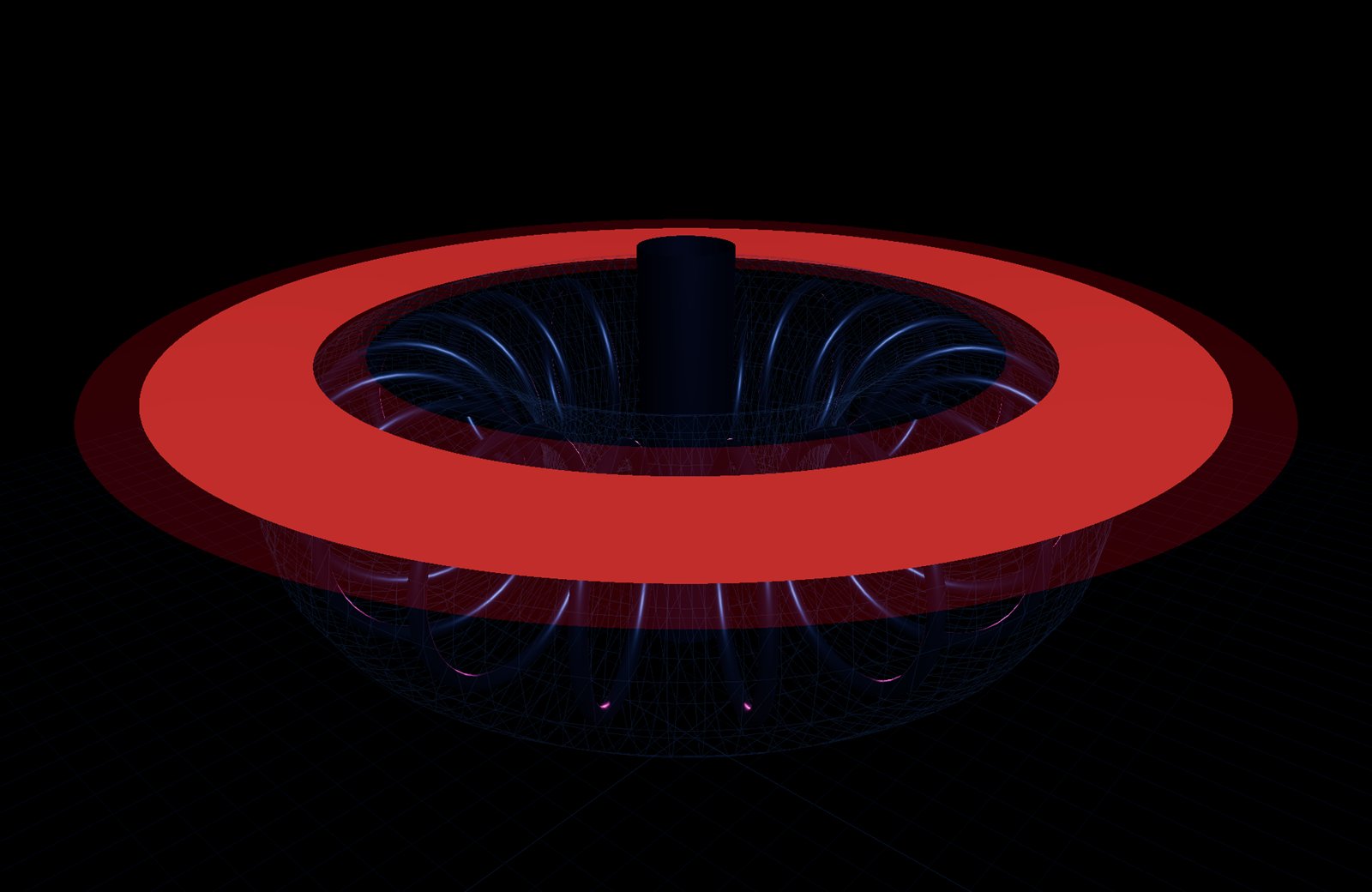
The killer act is the ghost. When your floor-legal-but-lethal command is forming, the Sentinel forks the sim, runs the future faster than real time, sees the disruption, and interjects before you commit — a warning that carries a receipt the physics will confirm or deny. A skeptic watching sees the whole thesis in one moment: continuous perception of forming speech, the future run on a forked branch, the catch before the seam, and a claim checkable against the tape. No essay and no benchmark can deliver that; the demo is built around it on purpose. And it generalizes: every machine is growing a language surface — the car, the grid, the machine tool, the surgical rig — and the reflex is to bolt on a chatbot. The reactor is the proof that the language surface of a physical system must be a resident on the control loop, not a service beside it. The same shape ships as play, too — a solitary starship simulator whose only crew is you and a mind that runs on your own weights, where the relationship is the game.
And read the courtroom correctly, because the surface reading — a human chatting with a reactor — is not the claim. Once the channels are fused, the resident itself does the watching: it monitors the plant in real time and aborts on forming evidence, and the human is not in the tight loop at all, because a human is latency there. The real architecture is three tiers, three clocks. The deterministic floor owns the microseconds — interlocks and PID, un-overridable, brittle by design, the alpha-floor that never gets smarter and whose whole virtue is that it doesn't. The human owns the writ — values, ratification, the decisions no record contains. Between them lies a band that went unstaffed for seventy years: roughly ten milliseconds to ten seconds, where the evidence is cross-signal and interpretive — this sensor drift plus that operator command plus this morning's maintenance log together mean the forming action is wrong. A script can't hold that thought; a human can't hold it in three hundred milliseconds; a turn-based model can't even arrive before the window shuts. The middle band never had a tenant. A resident loop is the first intelligence with the right clock to move in.
The direction of authority The resident never races the floor. It can abort anything the floor would have allowed; it may never authorize anything the floor would have tripped — the learned tier tightens the safety envelope, never widens it, the same fence as nothing learned decides what is true. And the human is not demoted out of the loop but promoted to the top of it: the talking is the governor channel — consent, audit, the writ — not the steering wheel. "Talks you out of killing it, with receipts" was always the governor conversation wearing a demo's clothes.
The core wire and the inverse Christmas tree
Scale the same shape up and it explains why the deployment industry keeps disappointing. Under its org chart every company is really two shapes at once. One is the core wire: the single irreducible end-to-end process that is the business — quote-to-cash, referral-to-transplant, engagement-to-filing. Everything scriptable along it was scripted decades ago; what stayed at each node was a human doing cognitive glue — open five systems, hold it in working memory, cross-reference, synthesize, push the result back. Thought-crunching, not number-crunching. The other shape is the inverse Christmas tree: the same org as a nested, fractal stack of cones, tip up, a human installed at every tip doing one operation at every scale — compress what rises from below, synthesize, re-emit upward. The CEO is the tip of the whole tree; he does not know the ground truth of his own company and does not need to, because by the time reality reaches him it has been pre-digested by every layer beneath.
Here is the keystone the whole thing stands on: a cone-tip's job description and a language model's training objective are the same operation — compress the context, synthesize, predict the next abstraction. Middle management and next-token prediction differ in clock speed, not in kind, which is why the swap is native rather than forced. It is also why AI is the new UI: every enterprise screen exists only to render database state pretty enough for a human compressor to read; give the model the representation directly and the interface layer dissolves into what it always was — a database, an API, and a compressor that no longer has to be a person. But a third shape comes first, and neither diagram shows it: the tape. Organizations don't log themselves; the real load rides the shadow wire — tacit knowledge, favors, the exception rules in a veteran's head. So the first act is never automation; it is instrumentation — watch the real traffic and mine the wire as a fold over observed reality. Tape first, then strike.
That discipline — mining the real wire and the tree from the tape — is Core Wire. It is exactly the second-order scripting the forward-deployed engineer does by hand: decide which wiring should exist, author it, and never rationalize a system you have only seen through its own propaganda. The resident kernel is Core Wire made resident — it runs the audit continuously instead of once, captures the human corrections into the ledger before displacing their carriers, and authors the wiring as exhaust: watch a tip's streams, handle it by hand the first time, notice the repetition, propose the standing automation for a one-word yes. The wiring everyone now pays an engineer to etch is supposed to be the residue of the system's own attention.
FDE → FTE compression Put a resident at each cone-tip and the eight-billion-dollar forward-deployed army — the confinement overhead — is what gets compressed. Not the intelligence: the manpower around it. The plant-Q goes positive exactly when the cognition a resident saves at its tip exceeds the human cognition it costs to keep it standing there. ↓ the ledger
The Copilot fallacy. Giving everyone a better email assistant is the steam-to-electric motor swap — bolt new power onto the old layout and gain almost nothing. The gains came only when factories were rewired around distributed motors. Copilot-for-all is the motor swap; core-wire re-architecture is the rewiring.
The seat-quantum law. Savings arrive in quanta of whole seats. Automate 30% of a node and you pay inference and the full salary; the step lands only when a seat closes. Diffuse augmentation disappoints because it is structurally incapable of closing seats.
The cascade. Most of a company doesn't work the wire; it supports the people who do, then supports the support. Close the cognitive tips and the pyramid of support obligations unwinds in reverse. You don't fire the org chart — you close the tips, and the chart follows.
Middle-out. Decompose the wage up the cone — cognition, accountability, presence, relationship. Only cognition collapses with inference. The base is presence-heavy (robot-gated); the apex is accountability-heavy (slow); the middle is pure compression with neither. The tree hollows from the middle out — the representation-passing layers are the native prey of a representation engine.
And the records compound into something no company has had. Each seat's kernel writes an append-only tape of what actually happened at its tip; fuse those tapes the way a phone fuses photographs into a walkable scene — a Gaussian splat, but of an organization. Each tape is a partial capture from one somewhere, registered to the others by the entities and timestamps they share; fit a field to all of them and you can render the view from any angle, including angles no employee ever occupied. So much of what looks like unanswerable judgment inside a company — "no one could have known" — turns out to be prediction starved of context; the field holds the cross-section no single person could, and converts it into "the record knew." Two lines it cannot cross, by architecture not policy: forming thoughts never fuse (only committed records do), and each person's record belongs to the person it records. A demesne is the opposite of a panopticon.
The org that reroutes itself
Believe the keystone — that a cone-tip's job is next-token prediction — and the org stops being a fixed diagram and grows three futures, each more ambitious than the last and each owed more fences than the one before: reroute, dissolve, rebuild.
Reroute — the control plane. Every business already runs a workflow fabric; it is just etched by hand. Wire a company's thousand tools together and you get what the automation platforms sell — a switchboard that routes events down pre-built paths — and it does nothing until a human authors every path, then re-authors them each time the business drifts. That switchboard is the dumb-fast router of the workflow world: the packets move fast, but nothing decides the routes or re-decides them. The brain it was always missing is a resident that routes work, not packets — and the blueprint already exists, in the one corner of infrastructure that solved exactly this: intent-based networking. You declare the intent (the mandate); the resident compiles it against observed reality into standing wiring (the exhaust); the surprise channel is continuous assurance that the world still matches the wiring; and when the business changes, the fabric reconverges on its own — re-etches the route with no human logging into the box to re-plumb it by hand. The control plane lifts up out of the humans' heads, where the real routing logic always secretly lived, into a fabric that can hold it. What does not lift is the intent — someone still says what the company is for.
The convergence law — F-KEEPUP, one clock up A self-routing fabric is autonomous only while its reconvergence rate outruns the business's rate of change. The instant the org drifts faster than the resident can notice, propose, and re-etch, stale wiring piles up and a human is pulled back in to re-plumb — turn-based again, at organizational scale, and no one decided it. And it must dampen: a fabric that reconverges on every twitch thrashes, exactly as a routing table flaps on a flickering link. Don't re-etch until the change survives a decay window. Route-flap dampening is the trained hold, six orders of magnitude up.
Dissolve — the org chart is a UI. "AI is the new UI" was said of the screen; it is truer of the whole organization. Departments, layers, span-of-control — these are not the business, they are a rendering, and what they render is one hardware limit: human attention is single-threaded, so the streams get sharded across skulls and the compression cascade is paid as rent. The cone exists because reading does not scale. Put a reader on the fabric that holds every forming stream at once — the thing no human tip can be — and the constraint that carved the cone is gone. And the history inverts under its own weight: every prior wave of automation made orgs bigger, because cheaper execution demanded more coordination and management grew for two centuries to supply it. This is the first wave that eats the coordination itself. The tree hollows from the middle out not by accident but because the middle is the most UI-like layer there is — pure representation-passing, no presence below it and no accountability above — the native prey of a representation engine.
Rebuild — greenfield, done as evolution and not as a clean sheet. A perfect map of the org is only worth having as a place to change from; the larger prize is designing, from first principles, how a company would run if it were built AI-native from tick zero, then working backward. But the clean sheet is a trap in a visionary's coat. The relic you would tear down holds one thing no fresh design has: it already survived its own catastrophes. Its idle-looking structure is often tail-insurance — the veteran who does nothing until the crisis only their relationship defuses, the redundant approval that is pure friction until the fraud it catches — and a design tuned to the average the tape can see will shatter in exactly the tail the tape never recorded. So the move is neither clean-sheet nor copy-the-relic; it is directed evolution: the relic is the warm start and the null to beat, first principles is the direction of search, the tape's rare events are the regularizer that keeps the search from overfitting the ordinary day, and reality is the oracle. Evolution never designed from scratch — that is why it ships both genius and the appendix — and it still outbuilds every clean sheet. The beachhead is not the incumbent's market either, but the newly viable one: the work that was never economic to do with human hands at all, at a scale no human org would bother to staff. You win first by addition to the possible, not subtraction from the entrenched.
And the last objection — that a human must remain to bear the blame — is true for a shorter while than it feels. Responsibility is a function: deterrence, restitution, trust, error-attribution — and every part of it survives on a fabric with no humans on it. What does not survive is the assumption that the bearer must be a body. The proof is four centuries old: a corporation is already a constructed, persistent, asset-holding, sanctionable person, invented to decouple liability from any single human — a self-owning loop that outlives its officers, animated until now by rented human cognition because nothing else could think fast enough inside it. The AI-native org is not a new legal monster; it is the corporation finally growing a nervous system. The line that truly holds is finer than "a human must sign": an agent can bear accountability the moment it has stake to lose — which is exactly what an owned loop, a record that cannot be cloned, and a real cost of dying provide — but who decides what counts as a violation is a value, not a fact, and stays imported from the sovereign. Bearing is substrate-independent; setting is the never-horizon. Strip the human mess that used to blur an org's objective and a greenfield company is all writ at the top — which makes whose hand holds the pen the entire question, not a footnote to it.
Reroute is a retrofit, dissolve is a consequence, rebuild is a bet — and the fences climb with the altitude, on purpose.
Said plainly, because the section is dangerous without it: none of this is an argument for emptying the building. A make-work seat is a person held present all day to catch the few bits that matter — a human paying the full cost of residency for a job that is nine-tenths waiting — and freeing that seat is meant to return the person to the one plane that stays theirs, the judgment and the writ, not to erase them from the record. And the reroute is dated like every other claim here: if by the end of 2028 no organization runs a resident control plane that measurably reconverges its own wiring and beats its turn-based twin at a real tip, this section was romance, and the failing number will be printed. A human still signs — and on a greenfield org, signing is the last job left, because it was always the first.
The rhyme — three Q's, and why the ROI hasn't come
Fusion has spent forty years "almost" working, and the reason is not one number but three. Scientific break-even (the plasma gives back what you fed it) gets the press release. Engineering Q — wall-plug to wall-plug, with the magnets and cryogenics that confine the reaction — decides whether it is a power plant. Labs cross the first and announce ignition while the second stays negative, because the confinement overhead eats the gain. That is AI's exact situation: the model crossed its per-token break-even long ago; what has not crossed is the deployment plant around it — the forward-deployed engineers, the workflow authors — drawing so much human cognition to keep it confined that the whole system runs at a loss. Eight billion dollars of engineers is the confinement overhead. The industry is announcing scientific break-even and calling it ignition, exactly as fusion PR has for four decades. Both run on the same physics underneath — order paid for by running down a gradient, the only grace the universe actually offers.
Ignition = self-sustainment A reaction struck from outside every cycle is not ignited. The resident kernel is the alpha-heating: its own output — the noticing, the automations it authors from watching itself, the disposition it tunes from its own record — feeds back and reduces the human energy needed to run it. Close that loop and the plant-level Q goes positive. Break-even was never the question. Self-sustainment is. ↓ the ledger
The ground — rent the intelligence, own the demesne
On the twelfth of June, 2026, an export-control directive reached a frontier lab at 5:21 in the afternoon; because nationality can't be verified at an API boundary, the only compliant move was to switch the model off for every user on Earth. It went dark within the hour and came back nineteen days later. Nothing about the weights changed; what was demonstrated was whose hand is on the switch. A rented mind is a tenancy — metered, revocable, governed by a memo you won't see coming. This is not an argument against renting intelligence; the frontier is genuinely best-in-class and genuinely someone else's to build. It is an argument about which layer you own. A demesne is the part of an estate a sovereign works directly and never leases. Rent the intelligence — it is a commodity, swappable by a line of config. Own the demesne: the loop, the tape, the accumulating record, the disposition tuned from it, the initiative on your own silicon. The laws are free; the intelligence rents; the record owns; and presence — the being-there — was never for sale, because it has no API. Push that past a single owner and it turns political: the very shutdown that proved the point is the case for intelligence returned to the commons — run on hardware anyone owns, not concentrated in three companies.
The LLM does not fly the plasma. The fast control loop — deterministic, classical, excellent — owns the servo. The resident owns the human-machine seam: the forming command, the narrated anomaly, the notice-before-commit on the operator's own action. Any claim that a model controls better than the controller loses, and deserves to. ↓ the real null
This is not a predictive fusion code. The physics is real, tiered, and honest, but the point is the difficulty class of the control problem, not machine-design relevance. The plasma is built to win so the demonstration means something. ↓ fidelity
The room with more than one human in it
Everything so far had one human plus minds — the desk, the reactor operator. Now put several people on the same fabric, because that is where this ships first, and it needs no tokamak. A rapid-response team — a trauma bay, an incident command, a trading desk in a bad hour — coordinates by typing at each other: chat windows, texts, a bot somebody added to the channel. Add a turn-based AI and it is a participant that helps between messages; useful, and blind in exactly the wrong moment. A person composing a critical message takes minutes, and for those minutes the turn-based bot sees nothing — not until send — while the world it needed to know about has already changed.
Here is the case no product touches. Two people, each mid-composition, are executing opposite actions — one typing the evacuation order, one typing hold-position — and neither can see the other's forming intent, and the bot can't either, until both hit send and it is twice too late. It is the reactor's whodunit exactly, except the minds are now people: each is structurally unable to see the evidence that would kill their own sentence. The fix is the same fabric. Humans become lanes on the WarpBus; a coarse cadence — every few words, every few seconds — makes their composition public at clause grain; and the resident watches every forming stream at once, which no human in the room can do, because human attention is single-threaded and everyone's is pinned to their own draft. It catches the collision at the seam, before either commits: "Sarah — Mike is drafting the opposite order right now." The AI in that room is not a participant who chimes in. It is the room's serializer and Sentinel — the one seat that can hold every forming thought at once.
And the payoff is larger than lower latency, for a reason worth stating precisely. In a coordination chain, turn-based inserts a full round-trip at every hop, and that merely adds up. The compounding comes from the correction loops: every conflict caught after commit costs a rollback — undo, re-coordinate, re-execute — and rollbacks breed their own conflicts. Streaming doesn't just shorten the hops; it deletes whole generations of rollback by catching contradictions before they commit. Convergence to ground truth in a crisis room is not message-latency-bound; it is wrong-action-bound, and wrong actions are born in exactly the window a five-minute composer is blind. Cut the visibility grain from minutes to seconds and you don't get a linearly faster room — you get a room where whole classes of divergence never happen.
The missing middle jury The desk grades presence in days — a luxury. The plasma grades it in milliseconds — physics. The crisis room grades it in minutes of human harm: fast enough that turn-based demonstrably fails, slow enough that no exotic hardware is needed, with a measure hospitals and incident commands already track — time-to-correct-action, conflicting orders caught, protocol deviations flagged. It is the before-commit membrane with no tokamak required — a team-chat bot on the surface, a WarpBus underneath.
Honest flag, from the estate's own receipts: this room needs the disposition tune most, not least. Five hundred interruptions an hour in an emergency room is not a nuisance, it is a casualty — and confusing content it is watching for content it is addressed by is the one failure a crisis resident cannot have. The highest-stakes room and the hardest tuning problem are the same fact, which is why the wedge waits on the weights — the correct order anyway.
The whole reactor — it was never just the loop
Everything to here has circled one organ: the instinct to emit — to notice, to speak before you finish, to take initiative — trained into the weights. That instinct is the spark. It is also, by itself, not a reactor. A spark in a vacuum is a spark; a spark inside a vessel that confines it, feeds it, and carries its own heat back into its own fuel is ignition. Getting those proportions right — spark, vessel, fuel, confinement — is the entire engineering problem, and it is the one every forward-deployed team is really trying to solve.
Wrap the spark in its organs and you get a single closed loop — a brain. At the center, the estate (DEMESNE): the emit instinct in the weights, riding the real-time WarpBus fabric — the etherpad bus where composition is public and a peer read is a pointer, not a re-prompt. Around it: cortex, memory over a hyperdimensional graph; scriptorium, massive-scale ingest that turns a lifetime of experience into lossless, append-only tape; and a seat — a view from somewhere, the registration point the whole picture is fitted to. Weights, fabric, memory, record, seat — closed onto themselves. Not a service you call; a thing that is on.
One brain is a tip. Stand one at every tip of the Core Wire — every cone in the cascade — and connect them in a Hypercell: a honeycomb, a Kubernetes for minds, an interconnected fabric of cells. Now everything a company runs on is connectored into a constellation of owned, always-awake brains that talk to each other at machine speed — the shape no organization has ever had.
And the swarm is what pays. Each brain's tape is a view from its own somewhere; fuse them — the Gaussian splat, but of an organization — into a rough field of what the company actually is. Then spray, then receipt: release the cells with the end state declared — mine the wire, map the tree, close every tip that clears the bar — solving forward down the wire and in reverse from the cone-tips at once. The machinery is MCTS + loop: fork the state, tournament candidate automations, let an external oracle grade them, prune, cross-pollinate, converge, loop until the loop closes. Emergence is enabled, never trusted — every swarm carries its null (one strong single cell at matched dollars; beat it or stand down), because an anthill only works when physics grades the pheromones, and an org's ground truth grades nothing on its own; it must be imported through receipts. This is AI that solves AI, pointed at the confinement, not the intelligence — not an AGI event but a closure asymptote, approached loop by audited loop. FTE compression at the scale the eight-billion-dollar army was hired to attempt by hand.
Sustained fusion, in one breath The spark must be baked in — presence, the initiative to emit — or there is nothing to sustain. But a spark alone is a demo. Sustained fusion is the spark plus the vessel plus the fuel cycle plus the confinement, all in proportion, closed into a loop that produces more than it consumes. The reactor you can talk to is one cell. The estate is the fuel cycle around it. The constellation is the plant. And at the tip of the last cone that still needs one, a single accountable human — minutes metered like dollars — commands the fleet that figured out the rest.
Most of the estate is public and MIT, and most of it is early. This section is the assembled-system view — the ten-thousand-foot picture of the whole package — not a shipped product. The discipline is the same as everywhere above: staked in the open, dated, and structured to lose honestly.
This is not a fusion project that happens to contain an LLM. It is a presence project that chose plasma as its courtroom — because plasma cannot be argued with, cannot wait for a turn, and issues its verdict in physics.
Everyone is racing to put the smartest mind at the interface. Put the smartest mind behind it, and put at the interface the only thing intelligence cannot substitute for: three small minds you own, in one room, never taking turns. The genius is downstream and rented. The room is yours. Presence is a tomorrow, owned.
Appendix Ω — resident cognition at cluster scale
Everything above the line was the argument; this appendix is the reference deployment. Deliberately dense; it drops the accessible register. Not the proof-of-concept (that runs on one consumer GPU) — the sketch for real deployment: resident tips served from H200-class clusters for enterprise operators. Most readers should stop at Altitude II. Equations are native MathML; LaTeX source is in comments. All K3 / vendor specifics are marked reported until re-measured.
Frame
Assumptions: a Kimi-K3-class open MoE (≈3T total, sparse-active, MLA-compressed KV; reported), H200 NVL8 nodes (8×141 GB = 1.13 TB HBM3e/node), and a managed SFT → preference → RL-rollout training path — the rung that lets the emit instinct be baked into frontier-class weights without owning the training cluster (reported; verify the vendor offering before relying on it). Not a PoC: a plant.
The emit decision as a marked temporal point process
The stream is one interleaved token sequence across lanes ℓ (mail, transcript, telemetry, ticks). Boundary detection is free: b_t = Σ_{v∈EOC} p_θ(v | x_<t) — clause-final mass off the ingest logits (0.97 vs 0.02, reference build). At boundaries the policy renders a ∈ {hold, emit(u)}. The right object is the conditional intensity λ_θ(t, ℓ | H_t) of a marked TPP: when-to-act is a component of what-comes-next, so timing is predicted, never polled. The objective, with interruption budget B (single digits/hr, not 593):
The key reframing: the runtime bias dial is the Lagrange multiplier λ, and the fine-tune's job is to absorb λ* into θ. F-INSTINCT (dial at zero) is exactly the test that the multiplier has been internalized — the constraint holds with no external λ term. The two-jaw vise (deaf where it matters vs. unlivable where it doesn't) is the empirical claim that no single runtime λ satisfies both constraints on the base model: the feasible set is empty until θ moves. That transfer to K3 is itself a bet — see F-VISE@K3.
Two nerves, not one — surprise at MoE scale
Per ingest token, surprisal is free from the pass already running; per-lane running state gives interoception, and its derivative gives curiosity/threat:
MoE adds a second free channel the dense model never had: router statistics. Per token you also get the gate distribution over experts; its entropy H(g_t) and its KL from the lane's running router profile D_KL(g_t‖ḡ_ℓ) are a representation-level familiarity signal orthogonal to token-level surprise — "a domain I don't have experts warm for." Two-channel interoception: the world surprised me and I am off my own map. The falter is the same channel turned inward. All of it is owned-loop-only: no API exposes ingest logits or router gates — the moat, restated at the logit level.
Router gates are trained for load-balancing, not calibrated uncertainty — so the second nerve carries the surprise-tap caveat: measured to exist, not yet validated as a signal (see F-NERVE), nulled against token-surprise-alone before any organ drinks from it.
The tune — three stages on the managed path
Stage 1 — SFT (train ≡ serve). Interleaved multi-lane stream format with lane headers, tick tokens, boundary markers; loss masked to decision tokens + utterances, never world tokens (the label-factory fence). Corpus: the self-play-against-the-tape generator (planted contradictions → mechanically verified emit labels, targeted at the measured under-fire taxonomy) + real-day ledgers (dense, real-distribution hold labels + watched-vs-addressed stance labels). The held-out 39-item set stays quarantined forever as the falsifier eval.
Stage 2 — preference. Pairs from the vise — (hold ≻ emit) from the over-fire ledger, (emit ≻ hold) from planted-evidence drills; length-debiased (IPO or length-normalized DPO — the same length trap the existing fine-tune pipeline already fights).
Stage 3 — RL via rollout — the reason the managed path matters. The environment is the replay soak itself: the recorded workday (and the sims) replayed at true cadence as an RL gym; reward computed mechanically per the Verifier Law's instant horizon:
// reward is graded against the tape, never by the model's own prose
r = catch(planted)  // did it flag the load-bearing item?
  − β · fires_over_budget       // long-run E[fires/hr] ≤ B
  − γ · stance_errors           // watched-vs-addressed confusion
  − δ · latency_past_boundary;  // decision timing, not wall-clock
// ship gate: F-INSTINCT @ dial-0 on the quarantined set  AND  fire-rate ≤ B on a held-out replay day
Because the record is the verifier, reward hacking reduces largely to corpus hygiene — but not entirely: the positive labels come from a synthetic planted-contradiction generator, so RL can learn its signature instead of genuine detection. The generator is the twin that must be built to win; F-SYNTH gates on a human-authored held-out set. K3-specific ablation, pre-registered: does disposition live in shared attention/MLP (router frozen), in router-bias-only (the cheapest possible knob), or both? Prior: stance lives high in shared attention; salience thresholds may live disturbingly cheaply in router biases. Ablate, don't assume.
The org field — the FDE → FTE mathematics
The tuned emit instinct (§Ω.1–Ω.3) is one seat's when. This section is what a fleet of such seats is for: the organization reconstructed as a fitted field, automation readiness computed instead of interviewed, and the forward-deployed engineer's entire job restated as gradient responses to one residual. Register as everywhere on this page: measured numbers carry receipts in the reference build's runs ledger; in-toy results are proved against a synthetic organization with planted truth; bets say so.
The field object. A cognitive seat is an anisotropic object in case-space — centre μ_i (what the seat is about), receptive field Σ_i (how far competence extends — wide on contracts, narrow on pricing; the anisotropy is the point), authority α_i (how much of a decision it terminates), source-mask m_i (the edge set — what it must see to decide), and the snapshot π_i — a frozen decision function with a ground-truth acceptance test. Learned: position, span, authority, wiring. Never learned: π's weights. The topology is the parameter; the intelligence is rented. And the fitted field needs no rendering equation the way photogrammetry does: the frozen snapshot is the per-seat forward model — drift enters only as versioned weight-events, never as a wandering lens.
The render is an escalation chain. A decision routes front-to-back along the authority order, each seat terminating what its competence covers, with a termination probability that is downstream-aware — an approver's willingness to close depends on what remains below (γ=0 recovers plain compositing, so the refinement is testable seat by seat):
The gift in the algebra In graphics, transmittance is light still unblocked. Here it is decision mass still unresolved — and T_final(q) > 0 is a decision nobody owns: a probability, integrable over case-space, priceable against the outcomes that land in that region. The gap between the cone tips, computed rather than intuited. The authority order is itself learned from who actually terminated — the real escalation chain versus the drawn one becomes a posterior, not an opinion.
The objective — and the term that is deliberately not one. Fitting the field is replay first, outcomes second, sparsity on edges and authority, a coverage cost on unowned decisions — under the writ as a hard mask:
λ_o(t) is the anneal that keeps this from cloning human error: it stays at zero until a seat decides correctly for the right reasons, then ramps. Parity licenses; outcomes improve. Humans supply the physics; search supplies the play — a veteran's bad Tuesday is terrible policy and excellent physics. And W is a mask, never a penalty: values are constraints an optimizer must not be allowed to price. The parity ladder grades every demo honestly: P0 same decision (trivially demoable) · P1 same decision, same cited evidence, survives ablation · P2 holds on shifted distribution · P3 better by the outcome oracle — the only tier that closes a seat. P0 without P1 is the dangerous state: right answer, wrong reasons, silent failure the moment the world tilts.
The closure calculus. Compression realizes value through three separable channels, each with its own precondition — and the whole program composes as a coverage objective, where greedy selection carries the legitimate (1−1/e) guarantee (in-toy):
| channel | mechanism | precondition |
|---|---|---|
| (i) at the seat | the resident supervisor absorbs the watching no one can afford to staff — it never signs, only narrows the envelope: a control in the auditor's sense, a category compliance has graded for a century | watcher cost < the salary share it releases |
| (ii) one layer up | partial automation at a tip closes whole seats in the support pyramid — the load that required the support never materializes; settles on the attrition clock | Lorg ≥ 2 — a pyramid must exist |
| (iii) ahead of the org | the hire not made — the next hire they can't find; at enterprise scale sold as replication: net-new hires per next territory | a growing firm |
The seat-quantum law — automate 30% of a role and you pay inference and the full salary — binds on channel (i) only; fractional-FTE work sells (ii) and (iii). Strike order: describability × criticality-coupling × cognition-share of wage ÷ verifier horizon — a seat can be 95% cognition and unstrikeable because its oracle answers in years, not because its cognition is deep.
Registration — the hard 70% — and the ceilings nothing crosses. Matching mentions across records is learned assignment (embeddings + Sinkhorn with a dustbin for "matches nothing"; hard constraints enter as −∞ masks before normalization; the soft plan proposes, an exact solver disposes; deterministic keys — invoice numbers, thread-ids — are free ground truth: mask them, train the matcher to recover them). What no machinery crosses:
Rmax is the co-observation ceiling (in-toy: 0.6209 measured vs 0.6207 predicted): how much of an organization is knowable is a closed-form function of how much its people witness each other — mint an ID for every record and 38% of alias mass stays unregisterable. Jitter has no pose (constant skew does), so the first deliverable of any engagement is a timestamp audit, not a model. The dependency chain is strict: clocks → registration → {distortion-vs-novelty · lie budget · readiness} → ignition. Keys are all-or-nothing per stream — a partial deterministic-ID rollout scores worse than none (in-toy; the valley is U-shaped). And structural vocabulary is Heaps-sublinear in instrumented seats: low-order structure saturates by n ≈ 8–12 — the instrumentation budget has a knee.
The two numbers a field computes. Criticality is read on the stock (backlog, lead time), never the flow; readiness is prequential, on the seat's typed decision alphabet, never raw tokens (on text, linguistic nuisance drowns the decision signal by orders of magnitude — typing the alphabet is the repair):
Δ(v) (in-toy: R²=0.996 where the LP-dual ranking scores 0.348; throughput-as-proxy falsified, τ≈−0.20) — vacations are the org's ablation study; the fitted field also predicts it free via seat-dropout during fitting, validated against the absence panel. Readiness ships as a tuple, never a scalar: READY(v) = (AR★, parity tier, n-support, per-seat Fano bracket) — the bracket is per-seat only; grading a high-readiness closure against outcomes needs on the order of n ≥ 3.6×10⁶ events (in-toy), so some closures are ungradable today and the honest contract says which. The watch-time law is a contract term: median N* = 425 events ≈ 4.47 calendar days to responsibly raise a proposal (max ≈14) — proposals are cheap to raise and expensive to refute; put the days in the statement of work.
Adversaries — there is no free lie, and the taxonomy is complete. Three lie classes, three detectors, one-to-one: alteration is caught by contradiction against co-witnesses, priced on the hypergraph cut of the witness structure (in-toy: partial ρ=0.936 controlling volume — price on the hypergraph, never its clique projection, which can invert the ordering); fabrication costs zero contradictions and leaves nothing corroborating it — caught by a base-rate detector (AUC 0.81–0.84 where raw surprisal reads 0.23: the fabrication class is invisible to novelty); suppression is invisible to both and visible against conserved object chains (continuity-break recovery 0.512 → 0.822). The defender moves first with the prospective shadow:
— the impunity a coalition would have, computable before it forms. Remediation is down-weight, never exclude (in-toy: dropping suspect tapes cost recovery F1 0.917 → 0.684 against an attack that cost the adversary ≈0). The free-lie budget is never zero (3.15% even at witness rate 0.95); every exposure figure is an upper bound against a non-adaptive adversary; and the cheapest attack is not lying at all but shaping who attends — zero lies, unchanged witness rate, recovery driven below chance — whose countermeasure, attendance design, is also the one lever that lowers confinement cost without touching θ, χ, or ρ.
The governor as a sequential test. Every automation carries a wager — a falsifiable expectation and an expiry that makes it re-earn its place. Promotion up the trust ladder (shadow → per-wiring → per-class → audit-by-exception) is an anytime-valid e-process over that wager ledger — the operator may peek forever without invalidating the test, which is exactly how a human actually supervises:
Demotion is set an order of magnitude easier than promotion because trust rebuilds asymmetrically — the measured hysteresis band (burnout at N=12.1, no re-ignition until N<2.7). And the audit floor ε* falls with class volume F but never reaches zero — the permanently-sampled review fraction that keeps acceptance-rate honest exactly when stakes rise.
Ignition, solved on its binding branch. §Ω.7's criterion has two algebraic branches and only one is real: the low branch is satisfied by a dead plant. The condition that binds:
The head theorem Every factor of L is a human-adjudication bandwidth: θ is ratifications per operator-hour; ρ is oracle bandwidth; χ — template transfer — is observable only across tenants, so no single-client engagement can evaluate ignition at all (the second client is the instrument, not just revenue); τ_a is shelf-life against a verifier whose legibility is permanent. Model capability enters the ignition criterion nowhere. Waiting for a smarter model is not a strategy; growing the adjudication surface is — deterministic verifiers first, vertical homogeneity, templated ratification, shelf-life engineering. The ceiling on FTE compression is oracle bandwidth, not model IQ. And concurrency is bounded: k* = ⌊ρ_total/ρ_min⌋ ≈ 1–2 for a small operator — ignite one client past the fold at a time; sub-threshold effort spread across five evaporates.
The scale structure. The axis is organizational depth, not headcount — every familiar threshold is an integer layer row of a span-5-to-8 tree, N(d,s) = (s^{d+1}−1)/(s−1), and the chain runs Lorg → approver count → signature authority → which rung is sellable:
| band | Lorg · N | binding constraint | the play |
|---|---|---|---|
| B0 | 0 · 1–2 | the operator is the workflow — no tape, no seat | a product, never an engagement |
| B1 | 1 · 3–30 | no cascade exists to unwind | point automations; price the unmade hire; farm χ |
| B2 | 2 · 30–150 | nothing binding — the design point | run the whole calculus; sell the principal before a committee forms |
| B3 | 3 · 150–600 | political metabolism — the middle is prey and veto | enter via a sub-cone; sponsor above the strike zone |
| B4 | ≥4 · 600+ | procurement wall + the irony ceiling κ→c_A | carve a depth-3 sub-cone; sell tempo, not cost |
Two claims, never one: the cone is scale-invariant (a shape claim); the cascade is not (it needs Lorg ≥ 2). And one venue sits off this axis entirely: a large codebase is the org-splat with the threat model off — registration free (symbols, hashes), oracle mechanical (the build, the tests), git already the tape — the zero-access venue where the field's claims meet their first honest contact.
The residual, routed — the FDE's job as five gradient responses. One free signal (held-out prediction error — the same surprise channel §Ω.2 taps), five responses, running as the sleep gear beside §Ω.3's flywheel:
// nightly, over the fitted field — every response is the residual speaking
if residual HIGH & localized      → DENSIFY   // add a camera, widen a lane — discovery, by gradient
if residual LOW  & sustained at v → PROPOSE(v) // the wiring, with its wager — readiness, measured
if residual AMBIGUOUS             → GROW-ORACLE // buy instrumentation exactly where it discriminates
if coverage gap E[T_final] > τ    → SPAWN     // a node type no skull could occupy: "watch fourteen
                                              // streams; fire when three jointly imply a condition
                                              // nobody named" — coverage of case-space, not staffability
if orthogonal to the map          → PERMANENT-DEFER // some dimensions are not purchasable
                                              // at any instrumentation price; enforced by schema omission
The standing constraints, printed rather than buried. Reflexivity — the organization best-responds to the installed field — is structurally unidentified at the served scale: within-org staggering violates no-interference by construction (coupling is what layers are, and it worsens with depth), cross-client staggering collides with k*, and both exits sit behind the same procurement wall that bounds the market. Every exposure figure is an upper bound against a non-adaptive adversary. Everything sits downstream of an extraction step — a k-support structure survives extraction recall ρ as ρ^k, so you can mine a map; you must instrument a defense. One synthetic world family so far. And: not one constant in this section has survived contact with a real business. The engagement is built so that contact itself — the audit re-run on pre-install logs, the absence panel, the wager ledger, the second tenant — is the experiment that finishes the equations.
The system the weights live in — weights are one leg
The three stages above tune a disposition into the weights. That is necessary and it is not sufficient: a tuned model with nowhere to stand is still turn-based. Deployment is the loop plus the fabric plus the record plus the governor — the weights are one leg of four, and the other three are where most of the engineering lives.
- The fabric — the WarpBus. A two-plane shared medium, not a message queue: an append-only, hash-chained tape (committed truth) plus an ephemeral word-grain reflex plane (composition public; a peer read is a pointer, not a re-prompt). Collaborative editor, not request/response DB — a SQLite table can persist the tape but cannot be the room. It is what makes the 1.208× triple and the mid-token cross-abort mechanically possible; at cluster scale, an in-VRAM structure per room with the durable tape on the training partition.
- The record — the durable tape. Per-tenant, append-only, replay-exact; disposition adapters enter it as versioned weight events (weights-as-events). The asset that cannot be cloned or rented, and the corpus the next tune is cut from — the loop feeding its own input.
- The governor — writs, never actuators. The cortex emits typed, revocable writs compiled through deterministic floors; refusals and acceptances both receipted (commit = governor-accept, tick-stamped). Autonomy is a dial in true risk order (log → confirm → delayed-cancelable → auto-within-envelope). Cheap cognition, expensive trust: the verification layer is the economic core, not compliance decoration.
- The seam. The line the tape is written at — forming/private on one side, committed/owned on the other. Everything above runs on it.
None of these is a model weight, and none is optional. "Own the loop" is shorthand for owning all four.
The WarpBus — a database custom-built for the loop
Tuning the disposition into the weights (§Ω.1–Ω.3) is one of the two load-bearing pieces of engineering. This is the other, and no off-the-shelf database provides it. The tape and the reflex plane of §Ω.4 need a substrate, and the obvious reach — SQLite, or any embedded store — is the wrong shape by construction. SQLite is disk-first, request/response, B-tree, row-locked, transactional: a passive thing you query. The WarpBus has to be the live medium the minds compute on, at token cadence, in VRAM. Doing it right means custom-building a database — as if Etherpad's live shared document and the fastest lock-free write-ahead log had a baby. Note the inheritance carefully: WarpBus takes from Etherpad its social property — composition public at word grain, everyone seeing the forming thought — not its OT/CRDT machinery. Those algorithms exist to merge concurrent edits of shared mutable text; the reflex plane is single-writer and append-only, so there are no conflicts to transform away and no algebra to import. What follows is the architecture and a reference sketch: a prototype, named on purpose, not a shipped system.
The load-bearing idea — the isometry. The WarpBus is not a store beside the model; the model's paged KV cache is its live plane. The two are isometric. One token slot in the bus is one entry in a PagedAttention-style KV block. A branch — a seat (Speaker, Skeptic, Sentinel, or a speculative ghost) — is a KV branch: it shares the trunk's prefix pages by pointer and owns a copy-on-write suffix. Reading a peer is attending over shared pages — a pointer, not a re-prompt. Aborting a forming thought is dropping suffix pages — O(pages), nothing re-done. Committing is sealing pages immutable and hashing them onto the tape. The schema is the KV page table, extended with lane tags, a hash chain, and one moving fence. One structure, two views: as attention it is the KV cache; as a database it is an append-only, branch-native log.
Because of the isometry, the prototype's headline numbers are already measured in the estate — a schema wrapped around operations whose latencies are on the ledger, not a hypothetical DB with hoped-for benchmarks: fork = 0 MiB (seq_cp pointer-share, m0-0) · abort = 13 µs suffix drop (m0-4) · the fold as a committed tape event, trunk rebasing 5,036 → 341 tokens with the planted needles surviving (M3) · and the durable tier's existence proof already green — durable.h + the m0_tape ctest: committed finals refold after restart, hash-chain intact; partials never persist.
Two planes, one page pool. The reflex plane is ephemeral, word-grain, VRAM-resident, and abortable — the Etherpad layer, where composition is public: every branch (and the human) sees a token the instant it forms, which is what lets evidence on one branch abort speculation on another mid-token. The tape is durable, append-only, and BLAKE3 hash-chained — committed truth, spilled VRAM → host RAM → NVMe, per-tenant, replay-exact. The seam is the fence between them: a monotonic, tick-stamped boundary that only the governor advances. Below it, immutable and owned; above it, forming and free.
The constitutional rule — multi-publisher, single-serializer, never multi-master Many lanes publish concurrently, but one arrival order per room is truth: a single serializer stamps the sequence. Cross-room consistency travels by capsule and replay, never by replication merge. "Etherpad database" must not be read as merge semantics — there is no God's-eye ledger to reconcile, and re-introducing one would reconstitute exactly the central authority the estate refuses.
The two planes are a type fence, not a policy. Reflex partials never persist to the tape — but they may flow to the flywheel (thought-as-exhaust; the training ledgers are exactly this). So the schema carries two distinct record types with no conversion path: writing a partial into the tape is a compile-time error, not a runtime rule someone remembers. A boundary drawn only in policy is not drawn at all; this one is drawn in the type system, and the battery drills it — attempt the illegal persist, assert refusal.
Why it outruns a locked B-tree — structurally, not incidentally. One writer per lane, appending to a lock-free MPSC ring; readers are wait-free (a pointer plus a version stamp — never a lock, never a copy). Pages are fixed-size, reference-counted, copy-on-write: a fork allocates zero new pages until a branch diverges, an abort frees in O(pages), and the molt reclaims folded pages to the pool. The 100 µs loop never blocks on a reader. And ingest is unconditional: every percept lands in a trunk page even under backpressure — overflow coalesces ticks, it never drops events, and a coalesce is itself a counted record (a silent drop is a defect class, the same law across the estate). Judgment and speech may shed drop-events under load; percepts, never. "Delay a judgment, never drop a percept" is enforced here, in the storage layer, or it dies quietly.
| dimension | SQLite | WarpBus (prototype) |
|---|---|---|
| substrate | disk-first B-tree | VRAM-first append-only log; host/NVMe spill |
| access | request/response query | resident stream — the minds compute on it |
| writes | row locks, ACID txns | single-writer-per-lane, lock-free MPSC ring |
| commit | a transaction | a moving seam (tick-stamped fence) |
| reads | copy rows out | wait-free pointer + version stamp |
| authorship | last-writer-wins | Etherpad-style — composition public, forming tokens shared |
| branching | — | native COW forks, isometric to KV branches (fork ≈ 0 memory) |
| abort | rollback via undo log | drop suffix pages, O(pages), no re-prompt |
| integrity | page checksums | BLAKE3 hash-chained tape, replay-exact |
// WarpBus v0 — PROTOTYPE (not production). In-VRAM, append-only, branch-native,
// two-plane fabric. Isometric to the paged KV cache: one token slot = one KV block.
// Inspiration: Etherpad's live shared doc, fused with a lock-free WAL — but the
// "document" is a token stream and the "authors" are resident model branches.

using Tick = uint64_t;
using Hash = std::array<uint8_t, 32>;          // BLAKE3 — tamper-evident tape
enum class Lane : uint8_t { PLANT, OPV, OPT, SPK, SKP, SEN, WRIT, SYS };

struct Page {                                // fixed token page; ref-counted; COW
  static constexpr uint32_t N = 256;        // = one PagedAttention KV block
  uint32_t              tok[N];                // token ids
  half                  s[N];                  // per-token surprisal -log p(x|ctx); stamped free at ingest
  half*                 kv;                    // device ptr -> the KV block itself
  uint16_t              used;
  std::atomic<uint16_t> refs;                  // shared-prefix count (fork = ++refs)
  Lane                  lane;
};

struct Branch {                              // a seat: Speaker/Skeptic/Sentinel/ghost
  std::vector<Page*> prefix;                   // shared, ref-counted — a pointer, not a copy
  std::vector<Page*> suffix;                   // private, copy-on-write
  Tick              head;                      // last appended tick
  Tick              seam;                      // commit fence: below it is immutable
};

// append a forming token to the reflex plane (VRAM, word-grain, abortable) — lock-free O(1)
Tick   wb_emit  (Branch&, Lane, uint32_t tok, half* kv_slot);
// fork a seat / speculative ghost — shares the prefix, allocates ZERO new pages
Branch wb_fork  (const Branch& parent);
// abort forming tokens at/after `from` — truncate suffix, drop KV blocks. No re-prompt.
void   wb_abort (Branch&, Tick from);
// commit: advance the seam, hash-chain the run onto the durable tape
Hash   wb_commit(Branch&, Tick upto, const Hash& prev);   // = blake3(prev || run)
// wait-free peer read: a span over shared pages — pointer + version, never a copy
std::span<const uint32_t> wb_peer(const Branch& other, Tick from);
# prototype build — CUDA VRAM plane + host-mirrored tape
nvcc -O3 -std=c++20 -arch=sm_90 --expt-relaxed-constexpr -shared warpbus.cu -o libwarpbus.so
# CPU-only reference (for the determinism / replay oracle):
g++ -O3 -std=c++20 -march=native warpbus_ref.cpp -o warpbus_refThe one genuinely new field — put the nerve in the page. That s[N] column is where the two halves of this appendix marry. Stamp each token's surprisal at ingest (§Ω.2, free from the same pass) and three organs collapse into queries over pages: molt retention becomes keep-what-cost-bits (the MDL rule, now a WHERE clause), gate cadence becomes probe-where-the-lane-runs-hot, and the flywheel corpus becomes select-high-surprise-spans-with-their-outcomes. The surprise channel stops being an idea and becomes a column — the fine-tune (§Ω.1–Ω.3) and the fabric (here) meeting in one field of one struct.
Its own falsifiers, because a prototype that can't lose is a mock-up:
- F-ISO — a fork shares the prefix and allocates zero new KV pages; the page equals the attention block whatever the architecture (under MLA, a compressed-latent block — F-TRANSFER covers it). Loses if per-branch expert activation forces private pages.
- F-ABORT — a mid-token abort completes within one scheduler quantum (~one micro-batch), never stalling the 100 µs loop.
- F-PERF — on the hot path, WarpBus beats the strongest cheap null — an mmap'd append-log with a WAL, never a strawman B-tree. If it can't, the hot-path claim dies.
- F-PLANES — the illegal-persist drill: attempt to write a reflex partial into the tape; assert it fails to compile (or, at the boundary, is hard-refused). A partial in the durable record is a failed build.
- F-REPLAY — the hash-chained tape replays bit-exact against a memcmp oracle; any divergence is a printed bug.
Honest scoping. WarpBus replaces SQLite only on the hot path — a different altitude, not a faster SQLite. SQLite stays the correct cold / cross-harness tier and the null arm; F-PERF races an mmap'd WAL append-log, not a B-tree. Every throughput number here is a design bet until a receipt says otherwise.
One structure, three charts: as attention it is the KV cache; as a database it is an append-only branched log; as physics it is the two faces — the unwritten and the written — meeting at the seam. SQLite answers "what did the world say?"; the WarpBus answers "what is the world saying?" — a database whose read primitive is attention.
Serving topology — two residencies
Topology A — council-grade residency. One NVL8 node = one room. K3 sharded node-wide; one kv_unified trunk (MLA compression makes 10⁵–10⁶-token trunks tens of GB, not hundreds; reported); N ≤ 8 branch sequences for Speaker/Skeptic/Sentinel + speculative forks. The 1.208× co-decode economics must be re-proven here:
Caution (F-TRANSFER): on MoE the branch role-headers steer routing, so co-decoded rows can activate a growing union of experts — the marginal seat could cost more than dense, not the same. The measurable is expert-activation-union vs N; the pre-registered prediction is that it grows sublinearly iff branch suffixes stay short (the molt's job).
Topology B — distilled membrane. Solver-then-distill: K3 authors teacher traces through the replay gym; an emit-native 30–70B student carries per-tip presence-residency at a fraction of the cost; K3 remains the contest-residency council, convened when the domain's verifier horizon is sub-turn. Fleet shape: student-per-tip on fractional nodes, one K3 room-node per campus, nightly consolidation on the training partition, per-tenant disposition adapters entering the log as versioned weight events — weights-as-events, replay-safe.
Throughput law (F-KEEPUP-Σ). J = Σ_ℓ boundary_rate(ℓ) ≈ 0.2–0.5 Hz per active human stream; probes are one-token and batch 8–16 wide per decode step, so a single node's probe ceiling covers hundreds of streams iff the surprise gate is doing the triage. The nerve is not a nicety at plant scale — it is the schedulability proof. (The arithmetic — boundary-rate × batch-width × probe-latency — is a receipt to be shown, not asserted.)
The ignition inequality — the cognitive-manpower ledger
The honest guillotine over the whole enterprise. Let C_saved be human cognition saved per unit time and C_confine the human cognition to confine it (setup amortized + maintenance + babysitting), over N deployed tips:
The trap is precise: if each deployment needs O(1) operator-weeks, the operator is the external heating and Q < 1 forever, regardless of model quality. Ignition requires the alpha-heating A — automations the resident authors from its own tape that reduce its own supervision — to exceed the loss terms L (drift review, ratification), with setup templated so C_build(n-th tenant) → const. The reactor builds the reactor: census → propose → ratify as the standard commissioning sequence, disposition adapters transferred and topped up per-tenant from their own dismissal stream. That per-tenant dismissal stream is also the moat. This is the harder half, and — like fusion's — it is not solved yet.
The falsifier battery at scale
Pre-registered; each can lose; published either way. The last three were added in review — the two starred are the difference between an appendix that sounds airtight and one structured to lose honestly.
| Falsifier | Claim under test | Loses if |
|---|---|---|
| F-INSTINCT@K3 | the tuned model's initiative fires correctly at dial-zero on the quarantined set | it only works with the scaffold's thumb on the scale |
| F-KEEPUP-Σ | multi-tenant residency holds boundary-grain latency, zero dropped percepts | sim time lags past budget, or a percept is dropped under a delta storm |
| F-TRANSFER | fork ≈ 0 new memory; abort survives MLA; ~1.2× holds under MoE | expert-activation-union grows super-linearly with N (the 1.2× breaks) |
| F-INVERT-TCO | cluster $/useful-action ≤ API-per-call at declared utilization | the owned loop costs more per useful action than the turn-based null |
| F-PRESENCE | resident beats the maximally-good turn-based twin on evidence-driven initiation | the event-triggered twin closes the gap (a result — it locates the advantage) |
| ★ F-VISE@K3 | the two-jaw vise still holds on K3 (no runtime λ separates the two failures) | a single runtime dial does separate deaf-vs-unlivable on K3 base — then baking-into-weights is unnecessary at frontier scale |
| ★ F-SYNTH | F-INSTINCT on human-authored contradictions matches the synthetic quarantine | the model only catches synthetic-signature contradictions — presence is fake |
| F-NERVE | router-KL predicts genuine domain-shift better than token-surprise alone | it is a load-balancing artifact, not a familiarity signal — then drop it |
The real null is not a chatbot. In a control room the incumbent is deterministic interlocks + PID/MPC + hard alarm ladders — fast, dumb, excellent — shipping in-binary as a runtime-selectable arm. The resident owns the human-machine seam; it never claims better servo control. And the plasma is built to win: real published formulas on a pinned synthetic machine, tiered and labeled, the difficulty a stated knob — never tuned to make the demo land. A strawman model would make the ghost theater; honest fidelity is what makes it admissible as evidence.
The mayfly condition, named and closed: each forward pass still dies with its final token. Personhood-grade continuity lives in the trunk + tape + adapters — a cursor over the substrate, not the substrate — which is why weights-as-events and replay-exactness are constitutional, not hygiene.
The dial is a Lagrange multiplier; ignition is its absorption into the weights; and the only hardware that can read the training signal is hardware you own.