Small tools. One job each. Free.
The INTELLECT·AI shop's Windows utilities — for the humans who run local models and agents, and for the agents working beside them. Most have no AI in them at all. That's the point: a model is only as fast as the machine around it.

Every tool, one line each.
The whole shop on one screen — what it does, what it hands an agent, where it runs. An agent working on your machine hits the same walls you do: it can't find the file, it can't see who is holding the VRAM, so it retries. These give both of you the same answer — a picture for you, a line of text for it.
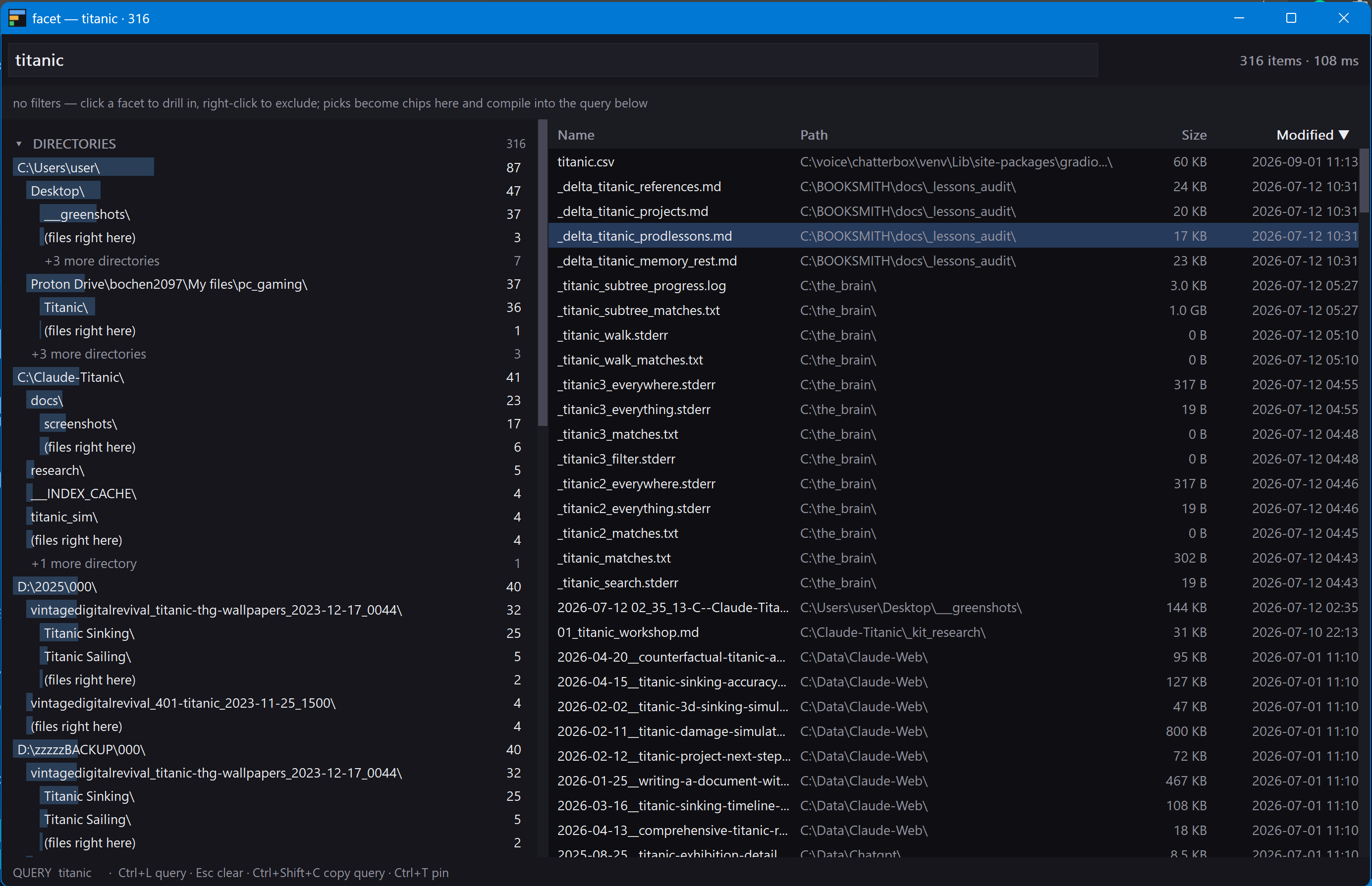
facet — file search you drill into, not scroll through.
Type a word. Every hit arrives with the folders it lives in, counted. Click a folder to drill in, right-click to exclude, and your picks become chips that compile into a plain query line. In the capture: 316 files matching "titanic" across two drives and seven roots, faceted in 108 ms.
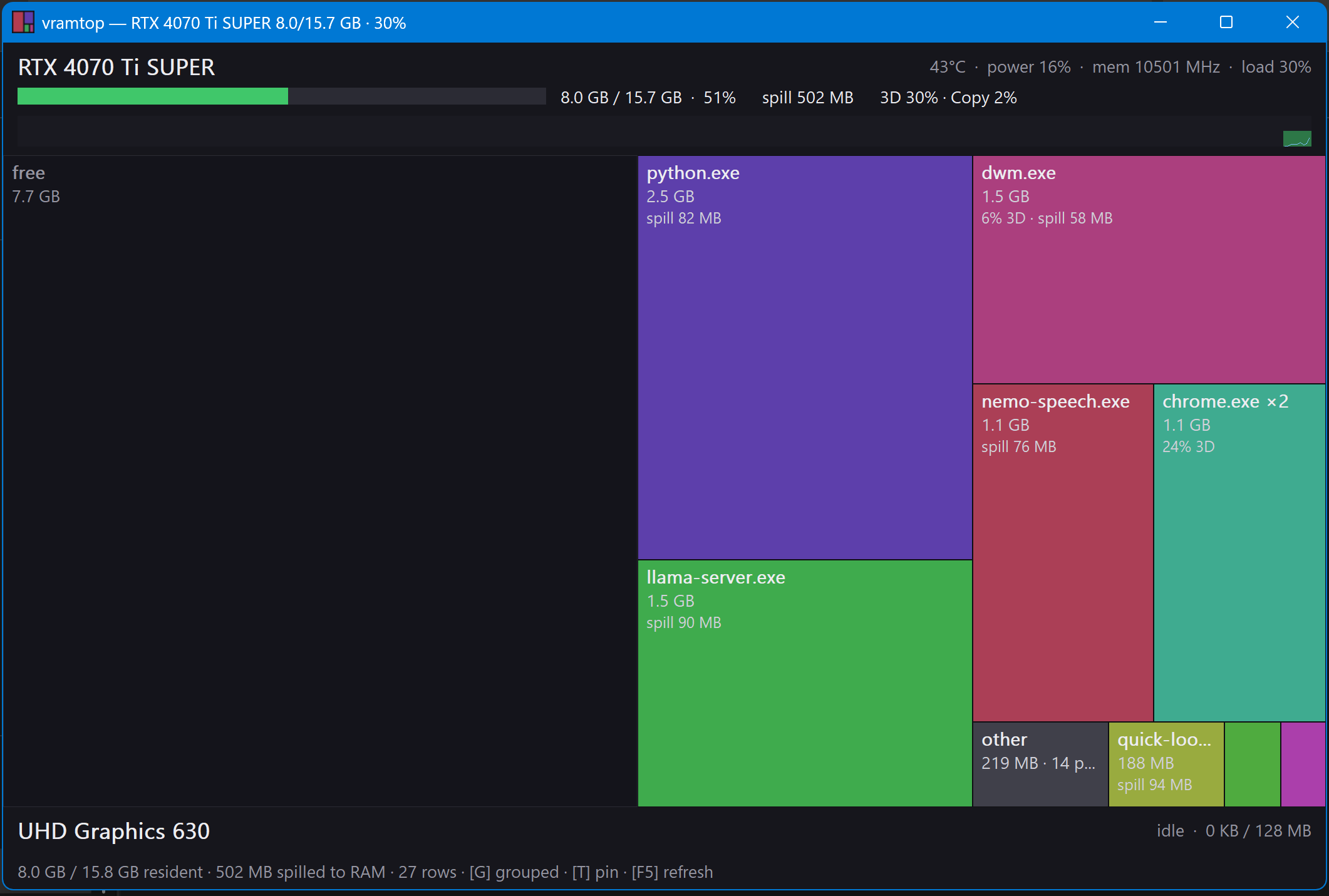
vramtop — top, for your GPU memory.
A live treemap of video memory, per process. Each tile is sized by what it holds, and "spill" is the part that overflowed into system RAM — the quiet reason a model that "fits" runs at a crawl. Temperature, power, memory clock and engine load across the top; every GPU in the box below, including the idle one.
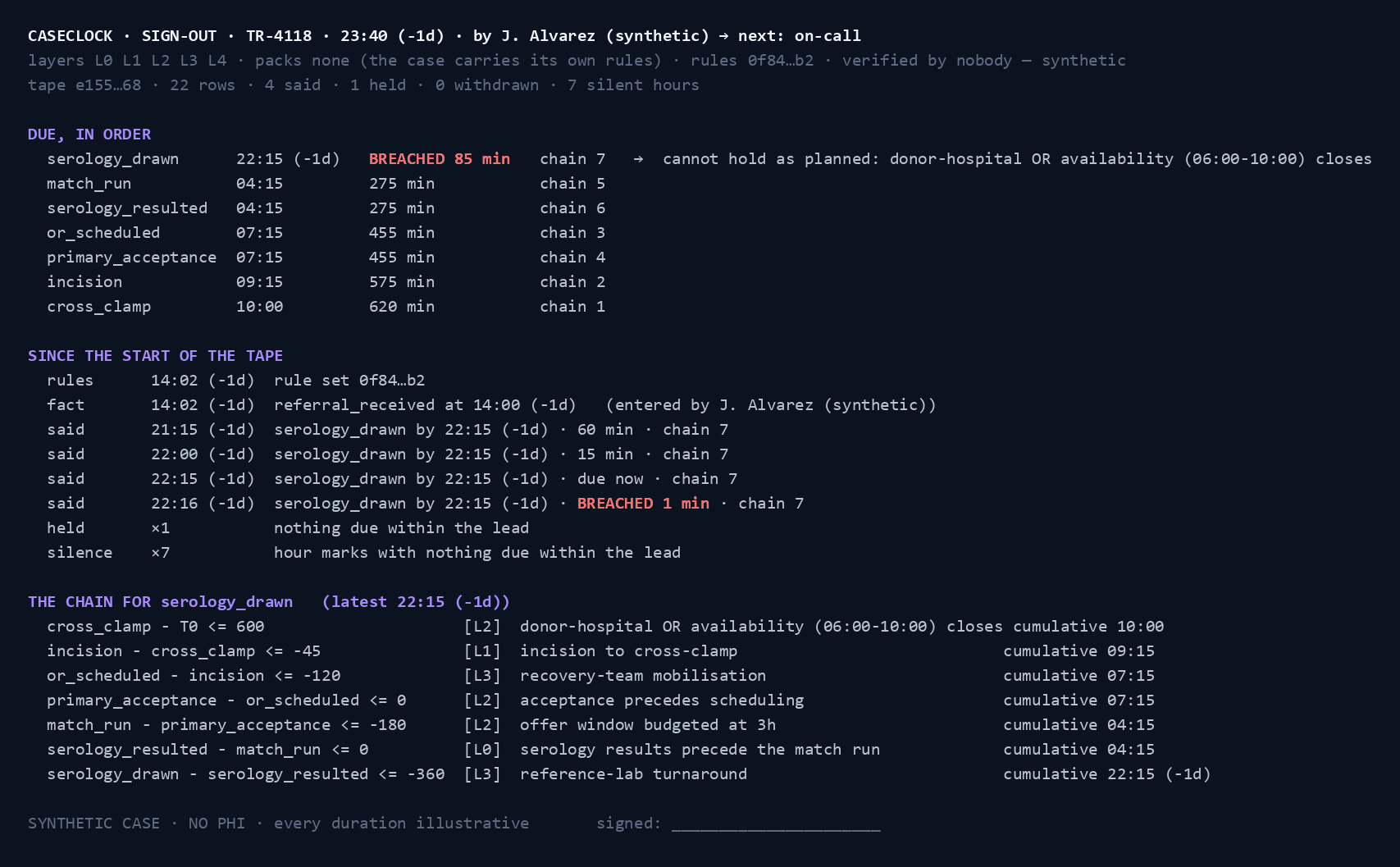
caseclock — every deadline the case implies, on a strip over the record.
A donor case runs under a clock, and the rules are all known pairwise: the lab needs six hours, the team needs two, the OR opens at six. Nobody multiplies them out — so the deadline that kills the morning OR window was 22:15 the previous evening, and it was written nowhere. caseclock computes it from the times already entered — a temporal closure in whole minutes, exact — and counts it down on a 28-pixel strip. No model. No network stack: the binary links neither Winsock nor WinHTTP, and the build fails if it ever does.

glance — the window, as text, as it changes.
Every other tool here reads something the machine already knows — the index, the card, the facts of a case. None of them can read a screen. On a transplant floor the record is a cloud application the OPO cannot integrate with, often reached through Citrix where the workstation sees only pixels; on a developer's machine, half of what matters is in a window an agent cannot see. glance reads both the honest way: the accessibility tree first, because it is text with names on it; pixels second, only where they changed, with the OS's own OCR. A window that does not change produces nothing — no line, no OCR, no CPU.
everywho — who is touching the disk, right now.
Task Manager tells you a number. It does not tell you whose number it is. everywho samples the kernel's own I/O accounting for a few seconds and puts identity beside every row: the account, the working directory, and — for a process that belongs to an agent — which harness and which repository it is working in. Nothing else on a Windows box will tell you that the writes you are watching belong to a coding agent in a particular project.
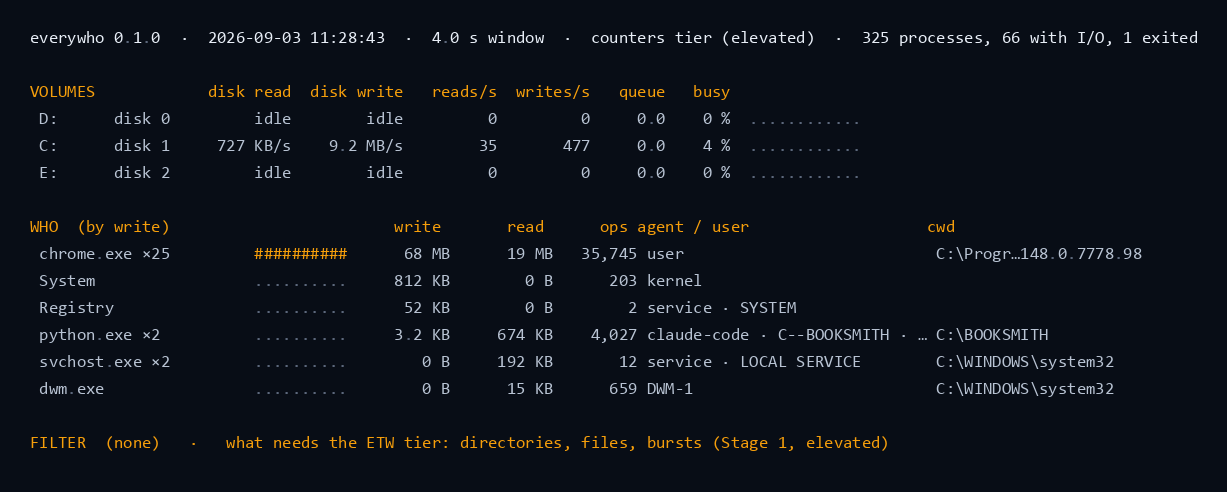
This is the counters tier — who and how much, not what. everywho cannot yet name the directories or the files behind a number. That needs a kernel trace session, which is the next stage and is not built.
The tool says so itself, on the last line of every report:
Shipping the honest half first is the point. A tool that guessed at file names would be worse than one that says which question it cannot answer.
It also reads its counters at the edges of the sampling window, so a process that starts and exits between two samples takes its bytes with it — measured at 24.9 % of a planted 129.8 MB at the default window, 76.9 % at a 60 ms one. Long-running processes are unaffected; the full page has the numbers.
everywhy — why these things belong together.
Grep finds the word you already know. everywhy finds the thing you can't name. It reads your own session transcripts and documents once, holds them as int8 vectors, and precomputes which chunks sit near which — so a phrase becomes a read plan: neighbourhoods, then sources, then the exact spans, each with the file and line to open. Pointers, never prose. It answers where to look, and stops.
Precompute the adjacency, never the answers. Answers can't be precomputed — phrasings are unbounded. Relations can, once. A phrase is a seed; firing is a plane cutting a fixed solid.
The plan carries a token budget, because the plan enters a context window. Anything that didn't fit is counted in an absent line, never silently dropped, and every plan ends with a stop rule stated first.
Same phrase, same store, same budget ⇒ byte-identical plan, proven by plan_hash. Int8 vectors and integer dot products make the scan reproducible by construction.
It is a where-to-look organ, not a what-is-true one. It ranks by semantic neighbourhood, which is not correctness and not recency: a wrong answer discussed at length will outrank a right one mentioned once.
It is wrong by omission by construction — index-bound, so anything since the last index does not exist to it. It can establish presence, never absence.
And it never summarises. The spans band is the only quotable thing, fenced as inert data — because the corpus is agent transcripts, full of imperative language written to another agent at another time.
fray — how much of this plan depends on nothing going wrong.
A plan is feasible or it is not, and caseclock computes that exactly. What it cannot say is whether the plan clears by four hours or by four minutes, and which single thing running long would end it. fray samples the durations the constraints assume — from a distributions file the site owns, not the tool — re-runs the closure over a few hundred thousand futures, and answers in one line. It perturbs durations, never people.
fray descends from a specification for a GPU demonstration that ranked organ allocations by score. That layer was cut, not adapted. These tools never determine organ viability and never make or override an allocation, so fray perturbs durations and says nothing about a person.
The boundary is in the loader, not in a comment. An action that names a recipient, an organ or a candidate is refused when the file is read, with its reason:
Its only counterfactuals are things the OPO does with its own resources: draw earlier, put a courier on standby, call a second crew.
nib — a writing surface with no send key on either side.
Every other tool on this page keeps the machine under a model honest. This one has the model in it. You type; it perceives as you type. When something you wrote deserves a word it writes one — into its own block, after the line it is about, prefixed with its name — and it will not write while your hand is moving. Pausing is how you yield the floor. There is no system prompt, because a mind that never forgets does not need to be re-told who it is.
The margin bars down the left gutter are what it wanted to say and did not. Those are on the tape too — a want that never became a sentence is a row, with its number.
Three mandates, three catches, on prose none of them was tuned on. Measured on this box; the run is in docs/devlog.md.
inspection-reconcile — never “ready” on evidence it could not see.
The work a project requires, against the inspection records, documents and approvals actually captured — every gap explained with the source rows it cites. The expected work comes from an accepted scope, never from the records being checked, and a missing record proves nothing unless the capture is known to be complete. Absence from a partial view is not absence.
It reads Quickbase through a read-only adapter mapped by field ID, and it is the one tool here that is not Windows-only: the same inputs give byte-identical reports on Windows, macOS and Linux.
A missing inspection, the corrected capture, and exactly the five findings that changed. Measured on this box; the scenarios and their oracle are in the repo.
What every tool here promises.
Six rules, printed once. A tool that can't keep them doesn't ship under this name.
Six shipped. What's the one you keep wishing existed?
The next tools follow the same six rules. If there's a small thing that would make your machine — or your agent's day — faster, one line is enough. The good ones are usually obvious once said.